Showing posts with label FILM DIRECTORS ON DIRECTING. Show all posts

Saturday, April 26, 2008

ON DAVID MAMET AT NYU GRADUATE FILM DIVISION: A PERSONAL REFLECTION

A few nights ago, Wednesday the 24th, to be exact, David Mamet spoke at the "Chair's Workshop" for the NYU Graduate Film Department, after a screening of his new movie READBELT.

It was the first time we'd seen each other since 1984. Up until that time we'd worked very closely together, for 7 years in the theater. David was my Mentor into show business, he gave me my first paying job as an actor, and my first teaching job at NYU with him, teaching those students who would found THE ATLANTIC THEATER COMPANY.

-- click on image to enlarge --

Summer '83 with original members of The Atlantic Theater Company

As to the aspects of "the work" of writing and directing that Mr. Mamet spoke of on Wednesday night, I thought that perhaps some insight might be of use to those in attendance. And, it comes in the form of a personal story.

As a student at THE NEIGHBORHOOD PLAYHOUSE, we were oftentimes invited to the productions of our school's alumni. David Mamet's AMERICAN BUFFOLO was one such event during my first year of study. It was running on Broadway, with Robert Duval, John Savage, and Kenneth McMillan. It was a riveting experience to watch three very fine actors, live moment-to-moment, in Mamet's landmark play about the dance between friendship and loyalty. To promote the play, David appeared for a late-night interview, with Duval, on the TOM SNYDER SHOW. During the interview, Mamet said, "I learned everything I know about playwriting from Sanford Meisner at THE NEIGHBORHOOD PLAYHOUSE."

Fast forward one year . . .

I'm in my second year now at THE PLAYHOUSE, a fellow student and I, go to see Mamet's THE WATER ENGINE, now also on Broadway. Standing in the lobby is the guy who said, "I learned everything I know about playwriting from Sanford Meisner at THE NEIGHBORHOOD PLAYHOUSE."

I approach him, "You're David Mamet, right? You said, 'I learned everything I know about playwriting from Sanford Meisner at THE NEIGHBORHOOD PLAYHOUSE!' What was that?" He introduces himself as David Mamet; he introduces me to some very important people nearby. We chat about "whatever/small talk" and, but I never get the answer to my burning question. This and other chance encounters around New York, which include David coming to see me in my first acting part in New York, an Off-Off-Broadway production of REBEL WITHOUT A CAUSE, lead to our working together for years. I never ask David that question again. But, and only, on Wednesday night 30 years since our first meeting, while David answered questions for the Graduate Film students did I get my answer.

It was right in front of my nose this whole time.

-- click on image to enlarge --

'84, Working on Mamet's adaptation of Anton Chekov's "The Cherry Orchard"

David Mamet loved the craft of acting about as much as anyone could love anything. But his gifts for acting were limited. The Theater was just behind his love for acting. So what did David do, learning that he would never be a decent enough actor to make a living that way in The Theater? David Mamet applied the principles from Sanford Meisner's teachings to: ACTING ON PAPER.

On Wednesday night, he kept saying that all The Actor, The Director and The Writer need know is the answer to three questions:

What does the character want?

What is at stake?

Why now?

Those are the first three elements of Sanford Meisner's INDEPENDENT ACTIVITY, and IMPROVISATION exercises that teach the essential elements, the "spine" if you will, of the Dramatic form:

ELEMENTS OF THE INDEPENDENT ACTIVITY

What are you doing?

What is at stake?

What is the urgency?

Where are you?

Each: Character, Actor, Writer, Director must know the specific answer to these questions, from Mr. Mamet's perspective, as identified by Sanford Meisner's teaching approach.

Then, answering a student's question about the Hero's "backstory", Mamet dismissing the need for "backstory", said something like, "YOU are the Hero." Meaning: from Mamet's subjective point-of-view, "You ask me how I write? I'm the Hero. The Writer is the Protagonist (and all other Characters for that matter) of the story! There is no 'Character.' The Writer is the 'Character'." Mamet's disregard for "backstory" has to do with his sensibility that, there is no need for "backstory" because you already know all you need to know to write the story, because you are the Protagonist (and everyone else in the story). You are writing about your understanding of life - trying to get what you want.

And with that, "DUH" I thought, as the light went on, in my mind. "THAT'S THE ANSWER TO MY QUESTION OF 30 YEARS AGO! DAVID ACTS ON PAPER! HE IMPROVISES ON PAPER!"

(Now, of course many of you writers probably, already, know this. But alas, I, obviously, am a slow learner.)

Mamet takes the elements of the INDEPENDENT ACTIVITY and rather than use them as an actor in live performance, he ACTs/IMROVISES with pencil and paper, within an IMAGENARY CIRCOMSTANCE that he creates from his life experience and imagination. Just as in SANFORD MEISNER'S IMPROVISATION EXERCISES, whereby two people with apposing WANTS come together, and make instant, riveting theater on the spot. David Mamet does the same on paper, and as the writing process allows, more, requires, these "paper exercises" can be re-written, polished and crafted to near perfection into those marvelous works that Mr. Mamet regularly creates.

Who would have thought that I'd have learned this in my role of doing "research" for teaching this very same thing in the Fall, right back here at NYU. Like DOROTHY in THE WIZARD OF OZ, who has the power to get home, at the beginning of the story, when the GOOD WITCH GLENDA gives here the RUBY SLIPPERS. I had the answer at my fingertips all along.

We all seem to have to make the journey to truly value and see the power of something that we already possess.

-- click on image to enlarge --

'81, Working on Mamet's "American Buffalo."
---
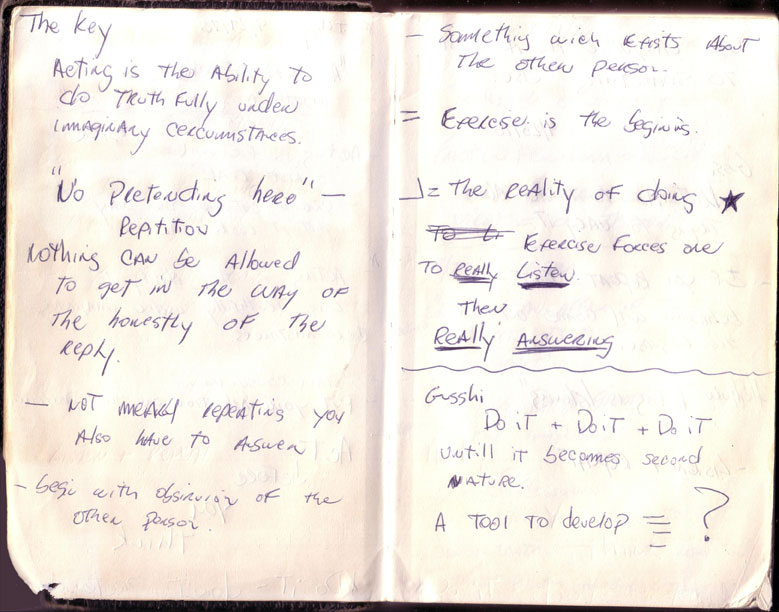
At the link below, one can find my journal notes from most of my first year of studying the same principles that Mr. Mamet studied, and with the same teachers. This information formed the foundation of our way of working together: A NEIGHBORHOOD PLAYHOUSE JOURNAL

This common knowledge formed the basis for our collaboration over 7 years, and on 3 original productions of his works. We ALWAYS referred back to Mr. Meisner's basic teachings, it was our language.

I imagine one of the best ways to deal with this material is to go to the archive and start from the beginning, because the learning was sequential and very systematic.

-------------------------------------

"There is no place like home."

Sunday, March 9, 2008

excerpt from: FILM DIRECTORS ON DIRECTING, BY JOHN ANDREW GALLAGHER

The following interview is reprinted from FILM DIRECTORS ON DIRECTING, BY JOHN ANDREW GALLAGHER

JAG: Five Corners is HandMade Films' first American film.
TB: It's their first American release and the first one they've financed. I would say that HandMade was pretty much long distance geographically in London, as well as practically speaking for most of the film until we finished shooting, then they had their comments about the cut, but it was pretty much a hands-off operation once we got started.

JAG: Once again, you've made a low-budget movie that looks big-budget.

TB: It's about as cheap as you can make a film in the mainstream today. It's a real movie populated with Screen Actors Guild members, a NABET crew, catered by a real catering company, so it was made in that sense like a $20 million movie. It only cost $5 million, largely because my producer, Forrest Murray, and myself, said we'd make it for $5 million. We like to feel we'll do what we say we're going to do.

JAG: It's also a period film.

TB: It's tough. It's a New York movie, shot all on location, set in 1964, with a lot of nights, and a very large speaking cast, so all of those things were major challenges to bring it in on budget.

JAG: With those kinds of pressures, how do you keep it from getting crazy?

TB: The only way to keep a movie from getting crazy is to not be a crazy person. I like to think of myself at the very least as a very professional and responsible filmmaker. If I say I'm going to make a movie for a certain price, which is basically what I say when I go into business with anybody, I make that movie at that price, and make the same movie that we all started to make, the same script we all started with, at the money we said we'd make it for.

JAG: How do you go about creating an atmosphere for the actors?

TB: You don't have to create that much of an atmosphere. You just have to prevent it from becoming the wrong atmosphere. You have to avoid letting it devolve into something it shouldn't be. It's easy to have a happy set, it's easy to have actors that are welcomed to be creative and a crew that is contributing to the spirit of the film and not just doing their job, because that's what everybody wants and that's what everybody gravitates toward. It's when you start impeding that atmosphere and start imposing an ego on it that things go wrong. In effect, it's really letting it happen as opposed to making it happen.

JAG: Do you rehearse much prior to shooting, or do you wait until you're on the location?

TB: I don't like to rehearse mainly because I really can't get much out of it. The idea of rehearsing a scene that say two or three people are going to play on an empty set is just too difficult for me. Until an actor sees it for real and can think, "Gee, look at all these things I have to play with," the things that the art director, prop master, or director thought to put on the set, it's pretty hard to rehearse because the rehearsal you might have undergone when you're working in an empty room goes out the window when you get on the set and find out there's table and chairs where you didn't think there was going to be one, or nothing where you thought something was going to be. I like to rehearse on the set with the actors under battle conditions of the reality of what's happening.

JAG: Do you find the actors respond better to that?

TB: For the most part actors do. Some actors feel that they need and want rehearsal time. I haven't come up against a situation where an actor so needed pre-shooting rehearsal that I felt they or the movie suffered because they didn't have it. Maybe some day I'll do a movie in which somebody says, "I just can't go to work without a week's rehearsal," so we'll find a way to do that. Basically, directing for me is solving the problems that you're presented with. It may be an actor problem, a location problem, or it might be that you get up in the morning and you have a weather problem. None of these things is insurmountable and they're all gonna happen. I don't have a method. My method is to do what's best for the actors.

JAG: What kind of preparation did Jodie Foster have for her Bronx accent?

TB: She worried about her accent. We found somebody who specializes in accents and we brought him out one day to work with her. In an hour or so, he said, "She's got it," and she did. Again, there's a problem you face and you deal with it however you can. In an hour, she got it fine. If it required her having somebody on the set throughout the picture, that would have been fine, too, but that was the solution to the problem.

JAG: John Turturro is outstanding as the psychotic Heinz, yet you also feel sympathy for his character.

TB: Turturro's character is a pretty amazingly violent and simmering personality. If you look at this picture cynically, you might see this guy has no redeeming values and he's a psychopath. But within the script there is the room, and John brought to it a humanity that most bad guys in the movies don't exhibit. That's based among other things on the notion that the prisons of this country are filled with terrible guys who've done terrible things, but outside that prison there's somebody that they love. There's a wife or kid somewhere, somebody that loves them, who sees something in them that the judge and jury will never see, a compassion or a feeling. They're not just murderers, they're not just bad guys. I'm happy to say that Turturro's character reflects that philosophy of mine that every bum on the street or every bad guy in prison was somebody's little boy.

JAG: Gregory Rozakis gives a very quirky and off-beat performance as the detective who talks about Indians in the Bronx.

TB: He was the star of Kazan America, America ( 1963). The first few days of shooting we did a lot of the detective scenes. In a sense I worried more about that than anything else in the movie because it set the tone for the other performances. It walked a tight rope. I wondered, "Is it too much, is it too far out?" Gregory didn't know it, but he was sort of the trial horse for the tone of the picture. He was great.
. . .

JAG: What qualities would you say are essential to the job of directing movies?

TB: I think everybody has different qualities that they bring to the job, but as a producer or as an actor I certainly have enjoyed most and benefited most from working with directors who embody the qualities of patience, human kindness, calmness, joy, and having fun doing your job. There's another school of thought that subscribes to the notion that great art comes out of this crucible of pain, suffering, and human conflict on the set. I just don't subscribe to that in my work, and so for me, the most important quality is the ability to lighten up, have a good time with your work and enjoy working with the people on the film. For me the process is the product. I don't really have a big stake in the success of a film in a personal way as much as I do have a stake in the process of making it. A movie takes a year of your life if you're working fast, from the moment you begin to know you're going to make the movie through pre-production, production, post-production, and the machinations of releasing it. You can't guarantee that a film will be well received critically, and you can't guarantee it will make money or that it will be well received by the public. But as a director, the headiness I feel, the power of the director, is that you can guarantee that the year will be a well-spent year of your life and that's almost my entire interest in making a film. Part of that well-spent year, by definition, is that you do the best work you can do, but not at the expense of enjoying spending the time doing it.

-----------------------------------------------------------------------------------
"The play's the thing wherein I'll catch the conscience of the king."