-----------------------------------------------------------------------------------
"The play's the thing wherein I'll catch the conscience of the king."
-----------------------------------------------------------------------------------
 -- click on image to enlarge and see the table of contents --
"Sonia's earliest understanding of Stanislavski's final deductions came from P.V. Simonov's book, The Method of K.S. Stanislavski and the Physiology of Emotion, which had not yet been translated into English. Simonov, a neurophysiologist, was the first to study Stanislavski from a scientific point of view, and he confirmed that the method of physical action is physiologically correct. According to Simonov, in Sonia's 1973 translation: "Stanislavski presents the thesis that in every physical action there is something psychological, and that the most complex psychological situations are expressed through physical actions ... In essence, Stanislavski's views exclude any possibility of subjective experience without physical expression." Stanislavski concluded that "direct reproduction of emotions is impossible," and that an actor could perform truthfully only by finding the physical behavior that would connect with the appropriate subconscious state."-- Stanislavski's Champion: Sonia Moore and Her Crusade to Save the American Theatre, Journal article by Felicia Hardison Londre; Theatre History Studies, Vol. 24, 2004.
 If you want to understand actors (and their lingo), just about every actor has read "An Actor Prepares."
 -- click on image --
 -- click on image to enlarge --
". . . It’s a law of theatrical physics that electricity is generated onstage only when a connection is made: between actors and audience, yes, but first of all among the actors themselves. And for whatever reason, everyone in “The Country Girl” seems to be operating on his or her own isolating frequency."(To read more.)
 -- click on image to enlarge --
It was the first time we'd seen each other since 1984. Up until that time we'd worked very closely together, for 7 years in the theater. David was my Mentor into show business, he gave me my first paying job as an actor, and my first teaching job at NYU with him, teaching those students who would found THE ATLANTIC THEATER COMPANY.
-- click on image to enlarge --
 Summer '83 with original members of The Atlantic Theater Company
As a student at THE NEIGHBORHOOD PLAYHOUSE, we were oftentimes invited to the productions of our school's alumni. David Mamet's AMERICAN BUFFOLO was one such event during my first year of study. It was running on Broadway, with Robert Duval, John Savage, and Kenneth McMillan. It was a riveting experience to watch three very fine actors, live moment-to-moment, in Mamet's landmark play about the dance between friendship and loyalty. To promote the play, David appeared for a late-night interview, with Duval, on the TOM SNYDER SHOW. During the interview, Mamet said, "I learned everything I know about playwriting from Sanford Meisner at THE NEIGHBORHOOD PLAYHOUSE."
Fast forward one year . . .
I'm in my second year now at THE PLAYHOUSE, a fellow student and I, go to see Mamet's THE WATER ENGINE, now also on Broadway. Standing in the lobby is the guy who said, "I learned everything I know about playwriting from Sanford Meisner at THE NEIGHBORHOOD PLAYHOUSE."
I approach him, "You're David Mamet, right? You said, 'I learned everything I know about playwriting from Sanford Meisner at THE NEIGHBORHOOD PLAYHOUSE!' What was that?" He introduces himself as David Mamet; he introduces me to some very important people nearby. We chat about "whatever/small talk" and, but I never get the answer to my burning question. This and other chance encounters around New York, which include David coming to see me in my first acting part in New York, an Off-Off-Broadway production of REBEL WITHOUT A CAUSE, lead to our working together for years. I never ask David that question again. But, and only, on Wednesday night 30 years since our first meeting, while David answered questions for the Graduate Film students did I get my answer.
It was right in front of my nose this whole time.

David Mamet loved the craft of acting about as much as anyone could love anything. But his gifts for acting were limited. The Theater was just behind his love for acting. So what did David do, learning that he would never be a decent enough actor to make a living that way in The Theater? David Mamet applied the principles from Sanford Meisner's teachings to: ACTING ON PAPER.
On Wednesday night, he kept saying that all The Actor, The Director and The Writer need know is the answer to three questions:
What does the character want?
What is at stake?
Why now?
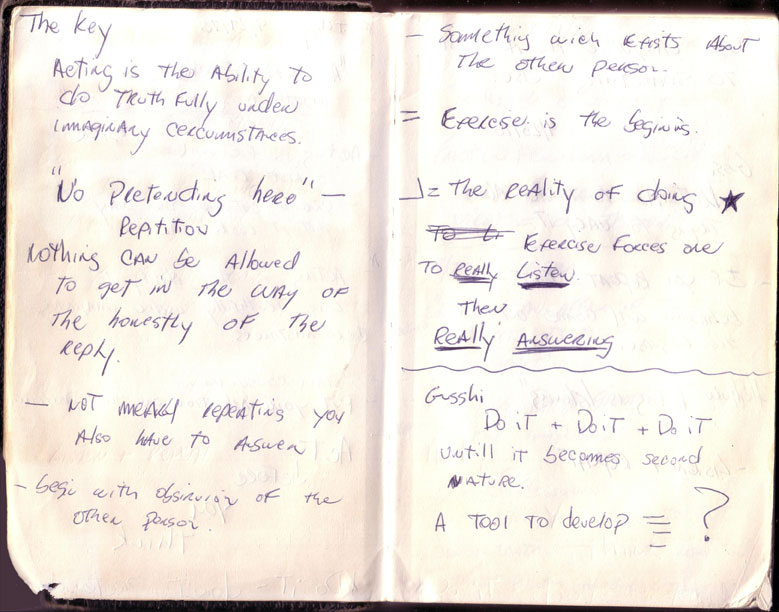
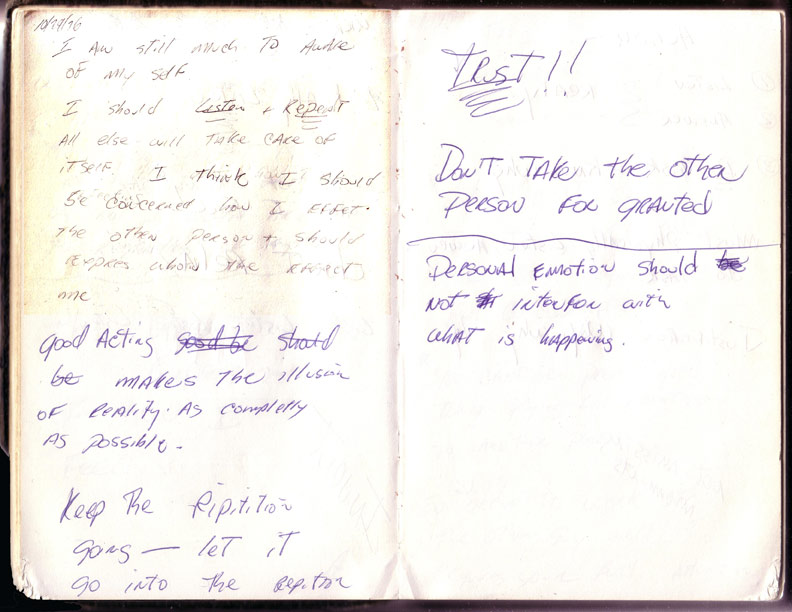
Those are the first three elements of Sanford Meisner's INDEPENDENT ACTIVITY, and IMPROVISATION exercises that teach the essential elements, the "spine" if you will, of the Dramatic form:
ELEMENTS OF THE INDEPENDENT ACTIVITY
What are you doing?
What is at stake?
What is the urgency?
Where are you?
Each: Character, Actor, Writer, Director must know the specific answer to these questions, from Mr. Mamet's perspective, as identified by Sanford Meisner's teaching approach.
Then, answering a student's question about the Hero's "backstory", Mamet dismissing the need for "backstory", said something like, "YOU are the Hero." Meaning: from Mamet's subjective point-of-view, "You ask me how I write? I'm the Hero. The Writer is the Protagonist (and all other Characters for that matter) of the story! There is no 'Character.' The Writer is the 'Character'." Mamet's disregard for "backstory" has to do with his sensibility that, there is no need for "backstory" because you already know all you need to know to write the story, because you are the Protagonist (and everyone else in the story). You are writing about your understanding of life - trying to get what you want.
And with that, "DUH" I thought, as the light went on, in my mind. "THAT'S THE ANSWER TO MY QUESTION OF 30 YEARS AGO! DAVID ACTS ON PAPER! HE IMPROVISES ON PAPER!"
(Now, of course many of you writers probably, already, know this. But alas, I, obviously, am a slow learner.)
Mamet takes the elements of the INDEPENDENT ACTIVITY and rather than use them as an actor in live performance, he ACTs/IMROVISES with pencil and paper, within an IMAGENARY CIRCOMSTANCE that he creates from his life experience and imagination. Just as in SANFORD MEISNER'S IMPROVISATION EXERCISES, whereby two people with apposing WANTS come together, and make instant, riveting theater on the spot. David Mamet does the same on paper, and as the writing process allows, more, requires, these "paper exercises" can be re-written, polished and crafted to near perfection into those marvelous works that Mr. Mamet regularly creates.
Who would have thought that I'd have learned this in my role of doing "research" for teaching this very same thing in the Fall, right back here at NYU. Like DOROTHY in THE WIZARD OF OZ, who has the power to get home, at the beginning of the story, when the GOOD WITCH GLENDA gives here the RUBY SLIPPERS. I had the answer at my fingertips all along.
We all seem to have to make the journey to truly value and see the power of something that we already possess.
 '81, Working on Mamet's "American Buffalo."
 -------------------------------------